By Mateus Alves, Boat Rent Split.
Updated 24 November 2026.
Part of Renting a boat.
Anchoring rules in Croatia: the short answer
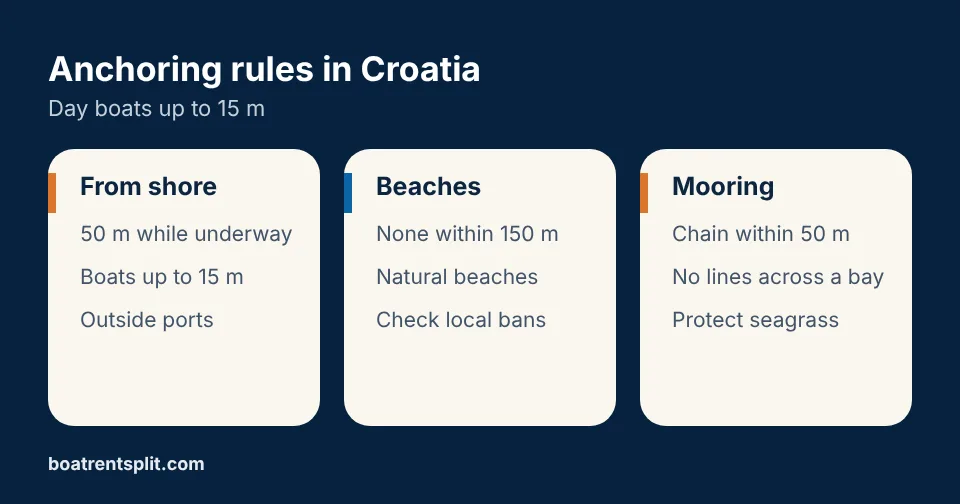
The anchoring rules in Croatia changed in April 2025 (Noonsite). For a day boat under 15 metres the points that matter are simple: stay at least 50 m from the coast while underway, do not anchor within 150 m of a natural beach, do not damage seagrass, and do not stretch lines across a bay. Local harbour authorities can add their own bans. Rules and practice can change, so confirm with your skipper or the harbour office on the day.
| Rule | What the sources say |
|---|---|
| Distance from shore, boats up to 15 m | At least 50 m while underway (Noonsite, SeaHelp). |
| Anchoring near natural beaches | Not allowed within 150 m (Noonsite). |
| Mooring to the coast | No part of the boat or its accessories may sit 50 m or more from the coast (SeaHelp). |
| Land lines | Stretching lines across a bay is prohibited (SeaHelp). |
| Seagrass | Mooring must not damage coastal vegetation (Noonsite). |
| Local bans | Harbour authorities can set time or place limits (Noonsite). |
We are a booking site, not a legal adviser. The sources above summarise the official ordinance. Check the current text if you plan to skipper yourself.
Anchoring rules in Croatia: distances from the coast
Two different distances are easy to mix up.
Distance from shore while underway
SeaHelp (13 July 2026) lists minimum distances from the coast outside ports and marinas: at least 50 m for boats up to 15 m, 150 m for boats of 15 to 30 m and 300 m above that. Motor operation inside those zones is generally prohibited, apart from access corridors. Most day boats from Split are under 15 m, so 50 m is the number to remember.
Distance when mooring to the coast
The mooring rule is Article 53(7) of the safety ordinance (SeaHelp). A boat may not moor to the coast with any part or accessory 50 m or more from the shore. The Ministry of the Sea clarified that the measurement is taken from the point where the anchor chain enters the sea, not from the end of the hull.
Anchoring rules in Croatia near beaches, buoys and protected areas
Noonsite reports that anchoring is not allowed within 150 m of natural beaches. Sailoscope adds that anchoring can also be restricted near swimming areas, cables and pipelines, concession buoy fields and protected national or nature park areas, and that practice varies by area and harbour authority.
Many buoys now sit in official concession zones. Fees there pay for waste collection and seagrass protection (Sailoscope). That source gives no euro amounts, so we do not quote any. If you see a line of buoys and a small sign onshore, assume you are in a paid zone.
A real example is the Pakleni Islands near Hvar. In Vinogradišće bay anchoring is prohibited and a buoy field covers the bay (Secret Adriatic). Our rent a boat in Hvar guide covers the other stops.
Seagrass, anchor lines and swimmers
- Seagrass. Mooring must not damage coastal vegetation (Noonsite). Anchor on sand where you can. It holds better and protects the seabed (Sailoscope).
- Marked lines. Anchor chains and mooring lines must be clearly marked and visible, and must not block other boats (Noonsite).
- Swimmers. Personal watercraft are not allowed in swimming zones (Noonsite). Whatever your speed, slow right down near swimmers. One guide quotes 5 knots within 300 m of shore (Sailoscope), but SeaHelp's July 2026 summary gives no knot figure, so we do not treat 5 knots as a rule.
Tenders and small boats: the 500 m rule
The anchoring rules in Croatia also cover tenders. If your boat carries one, note this rule. A tender without its own registration, insurance and Croatian vignette may generally move only within 500 m of the mother boat, with exceptions for trips between the anchorage and the nearest port or restaurant (SeaHelp). Stand-up paddleboards, jetboards and similar gear may only be used within 300 m of the coast (Noonsite). Most Split day rentals carry no tender, so this mostly matters on overnight charters. See bareboat charter in Croatia for those.
Anchoring rules in Croatia: what they mean when you rent a boat in Split
On a day boat with a skipper, the skipper picks the anchorage, drops the anchor and answers to the harbour authority. You swim. On a self-drive boat you carry all of it. That is a good reason to read the rules first and to check that your licence covers the boat. Use our licence checker and Croatia boat licence guide, or read skipper vs self-drive to decide.
Travelling with children? Read renting a boat in Split with kids for life jacket rules, calm bays and the best day length by age.
No source we read lists fine amounts for anchoring offences, so we do not quote any. Enforcement was reported stricter in 2025, with coastal patrols around the Split area (Sailoscope).
Questions to ask before you anchor
- Is this bay a no-anchor zone or a buoy field today?
- Is the bottom sand or seagrass?
- Are we more than 150 m from the natural beach?
- Does the harbour office have a time or place limit here?
- Who is responsible for the anchor on this rental, me or the skipper?
Ask the owner these before you book as well. Our boat rental in Croatia guide has a longer checklist, and renting without a licence explains what small boats may do.
Rent a boat in Split with local advice
We book day boats from Split with or without a skipper. Message us your date and group size on WhatsApp and we will suggest boats and bays that suit the day. See all boats for rent in Split or how it works.