By Mateus Alves, Boat Rent Split.
Updated 20 November 2026.
Part of Renting a boat.
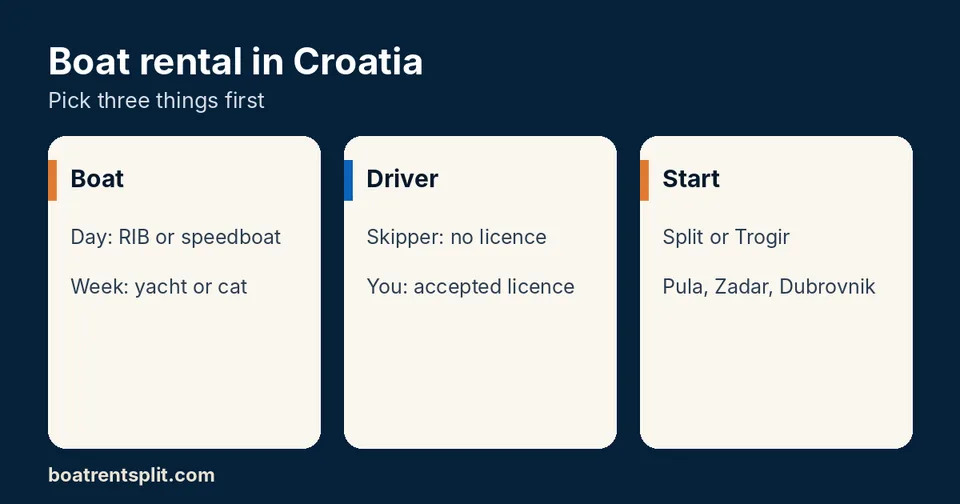
Boat rental in Croatia: the short answer
You can rent a boat in almost every Croatian coastal town. The choice that matters most is who drives. With a professional skipper you need no qualification of your own, says Absolute Croatia. If you drive yourself, the licence must be one that Croatian authorities accept for that boat. Everything else, from price to deposit, follows from the boat you pick and the dates you want.
There are two shapes of trip. A day rental is a RIB, speedboat or small motorboat for 4 to 8 hours, good for beaches and nearby islands. A charter is a sailing yacht, catamaran or motor yacht for several days, usually a week. Both are covered below, and you will see where each one makes sense.
| Question | Short answer |
|---|---|
| Do I need a licence? | Not with a skipper. To drive yourself, you need a certificate Croatia accepts for the boat. |
| Do I need a radio certificate? | Often yes on boats with a VHF radio. Ask the operator. |
| Day trip or week? | A RIB or speedboat for a day. A yacht or catamaran for a week. |
| Is a deposit normal? | Yes, on bareboat and many day rentals. |
| Best season? | June and September are calmer than July and August. |
| Where do I start? | Split and Trogir have the biggest choice of day boats and yachts. |
Rules and prices below were checked on 20 November 2026. Boat listings change by season, so confirm the details with the operator before you pay.
Boat rental in Croatia: day boat or multi-day charter?
A day boat is a rental by the hour or by the day. You pick up in the morning, swim, eat on an island and return in the evening. It suits first-time renters and short stays. Getmyboat lists more than a thousand boats in Croatia, from small powerboats to yachts, and shows day trips as well as longer charters.
A multi-day charter is a boat you live on. You sleep aboard, move to a new bay each day and pay for the boat by the week. Absolute Croatia points out that a seven-night charter does not always mean seven full sailing days, because check-in and check-out take up part of the first and last day.
Not sure which kind of boat rental in Croatia fits? Count your days. With one to three days on the coast, a day boat is simpler and cheaper. With a week, a yacht or catamaran gives you a different bay every night. If you have a week but do not want to sail, base yourself in one town and rent a day boat on two or three days. Our guide to whether renting a boat is worth it shows how that works out in Split.
Which boat to pick for boat rental in Croatia?
RIB or small motorboat
A RIB (rigid inflatable boat) or small motorboat is the usual day-trip choice. Absolute Croatia says these suit single-day trips to nearby beaches and coves, and that fuel use depends on engine size and speed. Our RIB rental page shows what a typical day looks like from Split.
Speedboat
A speedboat covers more water. From Split it reaches Hvar, Brač or the Blue Cave in a day. See speedboat rental in Split for the usual routes and group sizes.
Sailing yacht
A sailing yacht uses less fuel than a fast motorboat, and it is the classic week-long charter. Absolute Croatia warns that bareboat sailing needs real sailing experience. If you lack it, book a skipper.
Catamaran
A catamaran gives you more deck and cabin space, which is why families and groups like it. The trade-off is cost. Absolute Croatia notes a higher charter price and often higher marina and quay fees, because the boat is wider. Read our catamaran rental page for day charters in Split.
Motor yacht
A motor yacht offers speed, range and comfort, and fuel can be the biggest variable cost, according to Absolute Croatia. For a day with a crew, look at yacht charter in Split.
If you cannot decide, answer five questions in our which boat quiz, or read which boat to rent in Split.
Do you need a boat licence to rent a boat in Croatia?
You need one only if you drive. Absolute Croatia says guests who rent with a professional skipper do not need their own qualification. For a bareboat charter, the skipper's qualification must be one that Croatian authorities accept for the boat type, boat size and sailing area.
The Ministry of the Sea, Transport and Infrastructure says anyone who drives a foreign boat or yacht in Croatian waters must hold a certificate that allows it. The ministry publishes a table of foreign certificates it recognises, with the conditions and limits for each country. Our boat licence checker finds your country in that table in seconds.
Two practical points for boat rental in Croatia from Absolute Croatia. First, send a copy of your qualification to the charter company and get written confirmation that they accept it before you pay the final balance. Second, a valid licence is not always enough. The company can also judge whether you have enough practical experience for the boat you booked.
The full detail, including small boats under a set engine power, is in our guide to the boat licence in Croatia and our post on renting a boat in Split without a licence.
Do you need a VHF or radio licence?
On many boats, yes. Absolute Croatia says charter boats often carry VHF or GMDSS-VHF equipment, and a radio certificate may be needed depending on your qualification and the boat. Two charter companies state it more plainly: Croatia Yachting Charter lists a VHF licence as required next to your boat licence, and Ultra Sailing calls a valid sailing licence and a VHF radio licence mandatory for bareboat charters.
Check the exact entry for your certificate in the ministry table, then ask the operator which documents they want to see at check-in. With a skipper, the question does not come up.
Bareboat, skippered or fully crewed?
| Type | Who runs the boat | Good for |
|---|---|---|
| Bareboat | You. You choose route and schedule and handle navigation, weather, anchoring and docking. | Licensed, experienced skippers |
| Skippered | A professional skipper. You choose the plan together. | No licence, little experience, or no wish to dock the boat |
| Fully crewed | A skipper plus host, chef or deck crew. | The most hands-off week, at the highest cost |
The descriptions follow Absolute Croatia. On a multi-day skippered charter, check whether the skipper needs a cabin and whether meals are included. That one detail changes the price more than people expect.
For a day, the skippered option is the easy one. Read rent a boat with a captain in Split and skipper or self-drive before you decide. For weeks at sea, our guide to bareboat charter in Croatia covers what the paperwork looks like.
Best bases for boat rental in Croatia
Each base has its own waters. Absolute Croatia groups the main bases like this:
- Pula and Istria. The northern Adriatic. Routes include the Brijuni islands and the way towards Kvarner.
- Zadar, Sukošan and Biograd. Bases for Dugi Otok, the Zadar archipelago and the northern approach to Kornati. Good for multi-day cruising.
- Šibenik and Murter. Well placed for the Kornati archipelago.
- Split, Trogir and Kaštela. Routes to Šolta, Brač, Hvar and Vis, with a large choice of sailing yachts, catamarans and motorboats.
- Dubrovnik and southern Dalmatia. Access to the Elaphiti Islands, Mljet, Pelješac and Korčula.
Why Split works for most first-timers
Split has an international airport, a big fleet and islands within an hour or two. A speedboat day to Hvar and the Pakleni Islands is realistic, and the Blue Cave trip and the Brač and Zlatni Rat trip start from the same harbour. Our boats page lists everything we book there, and how it works explains the steps from message to boarding.
Yachtbooker puts Split to Milna on Brač at about 12 nautical miles and Milna to Hvar at about 16, so a slow sailing route to Hvar takes a day, while a speedboat does the crossing in around an hour (Frank About Croatia). Use the boat trip time calculator to check any leg at your boat's speed.
Other bases fit other trips. Pula suits Istria and the north. Zadar and Šibenik suit Kornati. Dubrovnik suits Mljet and Korčula. If you are still choosing your coast, our Split vs Dubrovnik and Trogir vs Split posts compare the bases we know best.
How much does boat rental in Croatia cost?
There is no single average price. Absolute Croatia says price depends on boat type, size, age, base, season, length of rental, skipper or crew and mandatory extras, and it advises you to compare the total trip cost, not only the headline price.
Still, a few real numbers help you judge a quote:
- Day boats. Getmyboat advertises Croatian boats from $70 an hour. For Hvar, SamBoat shows a general fleet from €50 a day and, as a seasonal estimate, about €500 a day for a catamaran in high season and about €300 in low season.
- Split day boats. On our boat rental prices page, Click&Boat listings in Split run from €187 to €1,650 a day, with an average of €668 (checked 17 November 2026).
- Weekly charters. Boatbookings lists bareboat sailing yachts at about €2,090 to €10,660 a week and bareboat catamarans at about €2,350 to €27,400 a week. The page does not name the season, so treat these as a range, not a quote.
The cost of a skipper, fuel and the deposit come on top of some listings. Our boat cost calculator adds them up for you, and the section on extras below shows what to ask.
What is normally included and what costs extra?
Ask for the full list in writing. Absolute Croatia suggests checking whether the price includes final cleaning, bed linen, towels, dinghy, outboard motor, gas, the base marina berth, Wi-Fi and any mandatory handling or transit package.
These are usually charged separately unless the listing says otherwise:
- Skipper or crew fees and crew meals.
- Overnight marina fees, tourist charges and national park entry.
- Fuel, which is commonly charged by use. The contract should state the fuel policy and the return condition.
- Transfers, paddle boards, extra towels and early check-in.
On week charters, Croatia Yachting Charter adds that a transit log or charter pack and residence tax are paid at embarkation, and that mooring costs about €50 to €70 a day for a 43-foot boat, with catamarans usually double. Some harbours and most anchorages are free. Responsible Travel says bareboat prices do not include food, mooring or anchoring.
Security deposits and damage waivers on a boat rental in Croatia
Bareboat and day-boat rentals commonly require a security deposit, and larger yachts can have much higher ones (Absolute Croatia). Payment may be a card payment, a card pre-authorisation or another method set by the company.
Two charter companies give figures. Croatia Yachting Charter says the deposit is roughly 0.5% to 1% of the boat's value, paid in cash or by card at the start marina and refunded in full unless damage is found. Its optional damage waiver costs typically 7% to 12% of the deposit. Ultra Sailing offers a waiver with a non-refundable part of €180 to €440 and a refundable part of €100, and says minor damage such as a lost fender, about €70, is charged at actual cost.
A waiver does not cover everything. Absolute Croatia tells you to check how sails, propellers, dinghies, outboards, lost equipment, blocked toilets, negligence and underwater damage are handled. If a company will not explain it in plain words, choose another.
What to check before boat rental in Croatia
Run through this list with the operator. It follows the checks in Absolute Croatia, with our own notes added.
- The exact boat. Model, year, layout and passenger capacity. Ask for the boat's own page, not a similar one.
- Your licence. Get written acceptance before a bareboat charter. Use the licence checker first.
- Mandatory extras. Ask for the full list and a total price.
- The deposit. Amount, payment method and when it comes back.
- Cancellation terms. Include what happens in bad weather.
- Fuel policy. Full to full, or charged by use?
- Skipper cabin and meals. Needed on multi-day trips with a skipper.
- Check-in and return times. A week does not always give seven sailing days.
- Equipment and help. What is on board and whom you call if the engine fails.
- Where you may go. The contract can limit the area.
Check-in and technical handover
On a week charter, check-in is usually on a Saturday. Croatia Yachting Charter gives 5:00 to 6:00 pm for check-in and 8:00 to 9:00 am for check-out, and notes that some companies use Friday afternoon with an overnight stay. Ultra Sailing puts standard check-in at 17:00 on Saturday and lists what happens at the desk: boat documents, a weather forecast, the crew list, tourist tax and the deposit. It also needs the skipper's licence number and each crew member's name, date of birth and passport number before departure.
Walk the boat with the staff and sign the equipment list. Photograph any scratch, and test the engine, the toilet and the anchor winch before you leave the dock. A day rental is shorter, but the same logic applies: look at the boat before you pay the balance.
Croatian boating rules every renter should know
These limits come from Absolute Croatia, which sums up the national rules for small boats. Local signs and harbour-master instructions can add more.
- Distance from shore. Boats under 15 m generally stay at least 50 m from the shore. Bigger vessels keep a larger distance. Entering or leaving a harbour or approaching a berth is the exception.
- Swimming areas. Boats under 15 m keep at least 50 m from the edge of an organised bathing area.
- Divers. Keep at least 50 m from the diver marker.
- Speed. A general limit of 8 knots applies within 300 m of the shore, in narrow channels and when approaching ports and anchorages.
- Anchoring. Generally not allowed within 50 m of an organised bathing area or within 150 m of the shore of a natural bathing area.
- National parks. Kornati and Mljet have their own vessel tickets and anchoring or mooring arrangements.
The Croatian National Tourist Board publishes a boaters' information page, and our licence guide lists the papers a boat must carry.
Weather on the Adriatic
Absolute Croatia names three winds. The bura is a strong, gusty north-easterly. The jugo is a south-easterly that often brings swell, cloud and unsettled weather. The maestral is the summer north-westerly sea breeze, useful for afternoon sailing. For small craft, the guide recommends the marine forecast from the Croatian Meteorological and Hydrological Service (DHMZ) over general weather apps. A good operator will also tell you when to stay in port.
When to book boat rental in Croatia
Absolute Croatia gives a month-by-month picture:
- May. Quieter harbours and good availability, but cooler water and more changeable weather.
- June. Long days and a warming sea, with less pressure than July and August.
- July and August. The hottest weather and the highest demand. Book early for popular boats and berths.
- September. A warm sea and usually less pressure than peak summer.
- April and October. Possible for experienced crews, with more flexibility needed on weather and services.
Responsible Travel says bareboat charters run from May to October. For a day boat from Split, our guide to the best time to rent a boat in Split goes month by month.
Island hopping with boat rental in Croatia
A rented boat turns the coast into a menu. From Split, the common day routes are:
- Šolta and the Blue Lagoon, the shortest hop.
- Brač, Bol and Zlatni Rat, for the famous beach.
- Hvar and the Pakleni Islands, the most popular full day. Our guide to renting a boat in Hvar shows how renting there compares.
- The Blue Cave on Biševo, a longer run. See also Split to Vis by boat.
Plan the day of your boat rental in Croatia with the boat day trip planner. It adds your stops and tells you whether the day fits in the hours you booked.
Two sample budgets for boat rental in Croatia
Numbers from the sources above make the cost easier to feel. These are sums, not quotes.
A day boat from Split for 6 people
Our prices page shows an average of €668 a day across Click&Boat's Split listings, checked on 17 November 2026. Split between 6 people, that is about €111 each. Split between 8, it is about €84 each. A small licence-free boat or a bigger yacht moves the total up or down, and fuel or a skipper may sit on top of the listing price. Work out your own total in the boat cost calculator.
A bareboat week for 6 people
Take the bareboat range on Boatbookings: about €2,090 to €10,660 for a sailing yacht. Add mooring at the rate Croatia Yachting Charter gives for a 43-foot boat, €50 to €70 a night, if you pay for a berth every night of a seven-night week. That is €350 to €490. The week then costs about €2,440 at the low end and €11,150 at the high end, before fuel, food, tourist tax and any waiver. For 6 people, the low end is about €407 each. The numbers show why a bareboat week is cheap per person only on a small, older boat and a quiet week. Read bareboat charter in Croatia for the full cost list.
Six questions to settle before you search for a boat in Croatia
- How many people? Capacity is on the boat's page, and it limits the boat, not the price.
- Which dates? Dates decide both availability and price. July and August are the busiest weeks (Absolute Croatia).
- Who drives? Skipper or you. If you, check the licence first.
- Do you sleep aboard? A day boat is back at the dock by evening. A charter is your hotel for the week.
- What is the budget in total? Include the extras listed above, not only the headline price.
- Which coast? Pick the base that matches the islands you want to see.
Answer these on paper and every listing becomes easier to rule in or out. Our which boat quiz turns the same questions into a recommendation.
Boat rental in Croatia: terms explained
- RIB. A rigid inflatable boat. A small, fast day boat (Absolute Croatia groups it with small motorboats for single-day trips).
- Bareboat. A boat without crew. You handle navigation, weather, anchoring and docking.
- Skippered. A boat with a professional skipper aboard.
- Security deposit. Money held against damage and returned when the boat comes back in order.
- Damage waiver. An optional fee that reduces what you pay for damage. It does not cover every kind of loss (Absolute Croatia).
- Transit log. A charter pack paid at embarkation on week charters (Croatia Yachting Charter).
- Technical check-in. The walk-round where you and the company sign the equipment list (Ultra Sailing).
National parks, anchorages and caring for the coast
Kornati and Mljet national parks sell their own vessel tickets and set their own anchoring and mooring rules (Absolute Croatia). For Kornati, Responsible Travel says the pass must be arranged in advance through your charter company, so ask when you book, not when you arrive.
Wherever you go, Ultra Sailing says do not discharge black water near the shore or in protected areas, and do not make open fires in coastal areas. Tap water on shore is safe to drink, but the boat's tanks are not for drinking. Keep rubbish aboard until you find a bin. These small rules protect the bays you came to see.
A simple plan for boat rental in Croatia
- Pick the type: day boat or charter.
- Pick the driver: skipper or you. If you, check your certificate in the licence checker.
- Pick the base and the dates. For the central islands, read Split to Hvar by boat.
- Ask for the total price, the deposit and the cancellation terms in writing.
- Send your licence and crew details if the company asks, and get written acceptance.
- Check the forecast the evening before and keep the plan flexible.
- At handover, walk the boat, photograph damage and sign the equipment list.
Boat rental in Croatia for first-timers: a safe place to start
If this is your first boat rental in Croatia, keep the first trip short and simple. Book a day boat with a skipper, so you need no licence, no radio certificate and no deposit worries beyond what the listing states. Choose a base with islands close by, so you spend the day swimming, not crossing open water. Split is the usual choice, and the trips to Šolta and Hvar are easy first days.
Leave the early start for the morning and the long lunch for the afternoon. Ask the skipper where the wind will be strongest and plan your swim stops on the sheltered side. Bring water, sun cream and a light layer, and read our list of what to bring on a boat trip. Once you know what a day on the water feels like, you can decide whether a week-long charter is for you. Many people find that two or three day trips are all the boat rental in Croatia they want, and that is a fine answer.
One more reason to start small: the paperwork scales with the boat. A day boat with a skipper asks for your name and your date. A bareboat week asks for licences, crew lists, a deposit and a handover. Learn the coast first, then decide how much of that work you want.
Booking platform or local operator?
You can book through a platform that lists many owners, or directly with a local company. Both work. SamBoat describes itself as an online platform with more than 50,000 boats from private owners and professionals, and Getmyboat lists more than a thousand Croatian boats and shows ratings from past renters. The advantage is choice and a standard booking flow. The cost is that each owner sets their own terms, so deposits, fuel rules and cancellation differ from boat to boat.
A local operator knows the harbour, the wind and the day's crowds. You talk to a person before you pay, and a good one will change the plan when the forecast changes. Whichever route you take, ask the same questions from the checklist above and keep the answers in writing. A skipper who lives on the coast also answers the questions a listing cannot: which bay is full on a Saturday, where the swell comes in, and which restaurant keeps a table for a boat that arrives late.
If you want a quote from a person who plans the day with you, send us your date and group size and we will reply with options. See how it works.
Boat rental in Croatia with us in Split
We book day boats in Split: RIBs, speedboats, catamarans and day yachts, mostly with a local skipper. You send your date and group size on WhatsApp and get options with prices. We do not run bareboat weeks, so for those you will deal directly with a charter company, and the checks above are your guide. If you are still comparing, our private boat vs group tour post shows how a day boat stacks up against a seat on a shared tour.
Mistakes to avoid with boat rental in Croatia
- Assuming your licence is accepted. Check it against the ministry table and get a written yes.
- Comparing headline prices. Add fuel, skipper, deposit, tourist charges and mooring.
- Booking the wrong size. A bigger boat is harder to dock in tight harbours. Responsible Travel suggests a smaller yacht for easier manoeuvring in town quays.
- Ignoring the wind. Check the DHMZ forecast the evening before, and ask the skipper to move the plan, not you.
- Leaving it late. In July and August the best boats and berths go first.
- Skipping the handover. Photograph damage before you leave the dock.
Also see the popular what to bring on a boat trip list before you go.