By Mateus Alves, Boat Rent Split.
Updated 20 November 2026.
Part of Planning your Split trip.
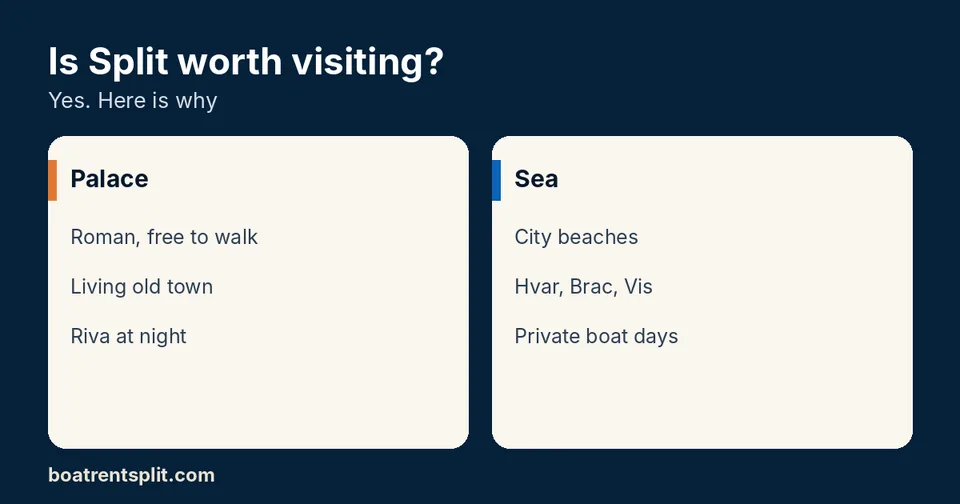
Is Split worth visiting? The short answer
Yes. If you ask whether is split worth visiting for a first Croatia trip, the answer from every guide we read is the same. Sunshine Seeker calls it a city with a lot to offer, from history to beaches, and Budget Your Trip says it is worth a visit if you like history, food and the sea. We agree, with two conditions: go with a plan for the crowds, and do not stay only in the old town. Use Split as a base, and the coast around it does the rest.
| Why go | Why think twice |
|---|---|
| Roman palace with a living old town | Cruise ship crowds in summer |
| City beaches a short walk away | Noise and a party feel at night |
| Free viewpoint on Marjan Hill | Plain concrete outside the old town |
| Hvar, Brač, Vis and Šolta by boat | Busy bus station and traffic |
| Trogir, Krka and Mostar as day trips | Summer heat and high prices in July and August |
What makes Split special
Split is not a museum. People live in it. The old town is built around and inside Diocletian's Palace, which UNESCO describes as a complex built in the late third and early fourth century, AD 295 to 305, as the retirement home of the Roman emperor Diocletian (UNESCO). Today it holds shops, cafes, bars and flats. You can walk straight through it for free, which is rare for a site of this age. Wonder and Sundry makes the same point and calls the palace the heart of the city.
The second thing is the sea. Split sits on a harbour with the Riva promenade along the front, and the islands are right there. You can have breakfast in a Roman courtyard and be swimming off a quiet island by lunch. Few cities in Europe offer that mix.
The best things to do in Split, and why it is worth visiting
Walk Diocletian's Palace
Start at the Peristyle, the central square, and wander the narrow lanes. Go early. Both Emma's Daydream and Wonder and Sundry list it as the first stop, and it is far calmer before the cruise groups arrive. The cathedral bell tower gives a roof-level view over the old town and harbour.
Stroll the Riva
The Riva is the waterfront promenade, lined with palm trees and cafes. It is where locals and visitors meet in the evening. A coffee here costs more than a coffee two streets back, so pick a spot one lane inland if you are watching your budget. Sit for an hour at sunset and watch the harbour fill with boats; it is free and it explains why people fall for the city.
Climb Marjan Hill
Marjan is the forested hill on the western edge of the city, and it is free. The view over red roofs and islands is one of the best in Split (Wonder and Sundry). Walk up in the morning or late afternoon, not at noon in August.
Swim at a city beach
The beaches named most often are Bačvice, Kašjuni, Bene and Žnjan (Emma's Daydream, Sunshine Seeker). Bačvice is the closest and the liveliest. Kašjuni and Bene are on the Marjan side and are quieter. Most are pebble or mixed rather than fine sand, so bring water shoes. Our view: they are fine for a quick swim. The better swimming is by boat, and we explain why below.
Eat the local way
Split has seafood, grilled fish and traditional Dalmatian dishes in the old town and in the quieter streets around it. Eat one meal a block or two away from the main squares, where the menus are shorter and the prices lower.
Island trips from Split
This is the reason to choose Split over a one-night stop. Emma's Daydream and Wonder and Sundry both point to Brač, Šolta, Hvar, Vis and the Blue Cave as the standout trips. Each one is a different kind of day:
- Hvar and the Pakleni Islands: a lively town and quiet bays right next to it.
- Brač and Zlatni Rat: the famous pebble beach at Bol.
- The Blue Cave and Vis: the Blue Cave glows in the right light.
- The Blue Lagoon and Šolta: a short, calm trip with a swim stop.
You can go by ferry, on a group tour or on a private boat. Ferries are cheapest but run on a fixed timetable. A group tour is easy but fixed. A private boat gives you the stops and the timing, and it costs about the same per person when you share it. See which boat to rent in Split, check the price table for boat rental in Split, or ask us for a quote on WhatsApp. If you are comparing the islands, read Hvar vs Brač by boat and the best beaches near Split by boat.
Day trips by land
If the sea is rough, or you want a change, Split is also a good base on land. Trogir is about 30 minutes away (Sunshine Seeker), and we compare it with the city in Trogir vs Split for a boat holiday. Krka National Park is a longer trip with waterfalls where swimming is allowed in designated areas. Plitvice Lakes is farther and is usually done on a tour. Mostar in Bosnia and Herzegovina is a full day, and Emma's Daydream lists it among the options. Compare Split with the south in Split vs Dubrovnik.
Inside the old town: what to see in an afternoon
The old town is Diocletian's Palace, and Wonder and Sundry points out that some parts are free while others sit with different institutions. Start at the Golden Gate, which marks the entrance, and walk into the Peristyle. Go down into the palace cellars if you want to see how the building was held up. The Archaeological Museum is the oldest museum in Croatia, and its courtyard holds stone sculpture and grave goods from Salona and the palace. Its labels are in Croatian, so read up first.
For a walk with fewer people, Wonder and Sundry suggests going round Marjan hill and not up the stairs. The route passes the small Oratory of St Cyriac behind the church of St Jerome, and there is a café at the viewpoint. Take sun cream and water, because Split gets very hot.
Day trips by land: what each one costs
Three short trips fit in half a day, and they make a good answer to the question of whether Split is worth visiting for more than the old town.
- Klis Fortress. It is under 15 km from Split. The bus costs about €3 each way, entry is about €10 and you need about 3 hours (Frank About Croatia). It sits between the Kozjak and Mosor mountains and fell to the Ottomans in 1537 (Total Croatia News).
- Salona. A Roman site about 6 km away with an amphitheatre, a basilica and sarcophagi. The bus is about €3, entry is about €8 and it takes about 3 hours (Frank About Croatia).
- Omiš and the Cetina River. About 20 km south, and up to 45 minutes in summer traffic. Rafting on the Cetina lasts about 4 hours with swim and cliff-jump stops. It costs €50 without a transfer and €70 with one from Split (Frank About Croatia). The town has a 13th-century fortress and you can zip-line over the canyon (Total Croatia News).
Krka is the long one. It is about an hour away, and you should plan 7 to 8 hours. Adult entry runs from €7 in winter to €40 in June to September (Frank About Croatia). For a boat day instead, read Split to Hvar by boat and Split to Trogir by boat.
The downsides of Split
We want you to know these before you book.
Crowds. Split is a major cruise and ferry hub. Sunshine Seeker notes that it receives well over a million cruise passengers in a season, and the old town can feel packed in July and August. Go early in the day or in the evening, and travel in June or September if you can.
Noise and the party scene. The old town has bars and clubs, so it can be loud at night. If you want quiet, stay a few streets out or choose a room facing a courtyard.
The area outside the old town. It is a working city with concrete housing blocks and a busy bus station (Sunshine Seeker). That is normal for a city of this size. Do not judge Split by the road from the airport.
Heat. Summers are hot, with an average near 26°C (Budget Your Trip). Plan sightseeing for the morning and the sea for the afternoon.
How many days do you need in Split?
Most guides say 2 to 4 days. Emma's Daydream builds a two-day plan, and Wonder and Sundry covers more. Our advice:
- 1 day: palace, Riva and Marjan. Enough for a taste.
- 2 days: add a beach afternoon and a half-day trip such as Trogir (see Split to Trogir by boat).
- 3 to 4 days: add a full boat day to the islands and one land trip such as Krka.
The extra day is for the weather. If the wind picks up on your boat day, you move the trip to the next day and nothing is lost.
When is the best time to visit?
For swimming and boat days, June to September. For fewer people and lower prices, May, June and September are the sweet spot. July and August are the hottest and busiest months. Winter is quiet. We cover the month-by-month picture in the best time to rent a boat in Split.
Getting around Split
The old town is walkable. Most visitors never need a car in the city. For longer trips, Wonder and Sundry mentions the Promet city bus app, Bolt taxis and Flixbus coaches for intercity travel. A rental car is handy for Krka or Plitvice, but parking in Split is a headache, so book a place with parking or use a public lot.
What does a trip to Split cost?
Split is one of the cheaper big stops on the Croatian coast, though July and August push prices up. Eating is where you save: choose konobas, small family restaurants, away from the Riva. The tour is where costs add up. Budget Your Trip breaks out typical daily costs for the city, and we suggest checking it for current figures. For the sea, a private boat shared between friends often costs less per person than a group tour. See all boats for rent in Split for the range.
Where to stay
For a first visit, stay in or near the old town so you can walk everywhere and reach the Riva for boat trips. If you are sensitive to noise, pick a side street or a place a ten-minute walk out. Book early for July and August, because the best rooms go first.
Who should skip Split, and who should not?
Skip it, or at least shorten it, if you hate crowds and cannot travel outside summer, or if you want a small, car-free medieval town and nothing else. In that case, look at Trogir. If you only want museums and nightlife with no sea, a bigger European capital will do more for you. For everyone else, is split worth visiting? Yes.
Split through the seasons
Spring (April and May). Quiet, cool and cheap. The sea is still cold for swimming, but the palace and Marjan are at their best without the crowds. Many boat trips start in late spring, and the first warm days are lovely.
Early summer (June). Our favourite month for a first visit. The days are long, the sea is warming and the cruise crowds have not peaked. Boat days are easy to book.
High summer (July and August). Hot, busy and the most expensive. Everything is open, the water is warm and the nights are long, but you pay for it in crowds and prices. Book rooms and boats early (Sunshine Seeker flags the cruise crowds in these months).
Early autumn (September). Still warm, with the sea at its warmest after a summer of sun and fewer people. If you can pick any month, pick this one or June.
Winter. Mild and quiet. The old town is much calmer. It suits a city break, but it is not the season for boat days.
Is Split worth visiting for different travellers?
First-time Croatia visitors. Yes. It is easy to reach, easy to walk and a strong base for the coast.
Couples. Yes. Sunset on the Riva, a quiet dinner and a private boat to a hidden cove make a good trip. A skipper makes it simple, and you can read rent a boat with a captain in Split.
Families. Yes. The old town is mostly flat and car-free, the beaches are close and a short boat day works well with kids. For ideas, see small boat rental in Split.
Groups of friends. Yes. The bars and beach clubs are here, and you can add a boat party in Split.
Solo travellers. Yes. Hostels, group tours and a walkable centre make it easy to meet people.
History fans. Yes, but pair it with Salona and Trogir for more depth (UNESCO lists Trogir as a World Heritage site).
Eating in Split
Food is a big reason people say yes when they ask is split worth visiting. Expect grilled fish, squid, octopus salad, black risotto and slow-cooked beef dishes, plus plenty of olive oil and fresh vegetables. The Green Market near the palace sells fruit, cheese and cured meats, and it is good for a picnic to take on a boat.
A few simple rules help. Look for short menus, because a long menu often means frozen food. Ask what the fish of the day is. Skip tables with a person waving menus at you on the Riva. And book dinner ahead in July and August.
Nightlife in Split
Split has a real party side. The old town has bars in the lanes, and the Bačvice area has beach clubs. If that is your thing, it is a plus. If not, pick a quiet street, wear earplugs or sleep at the edge of town. Sunset drinks on the Riva or at a hill viewpoint are a calmer option.
A boat day from Split: is it worth it?
For most guests, a boat day is the best day of the trip. You skip ferry timetables, you choose the bays and you swim where the water is clearest. A typical rental boat day starts in the morning, covers one or two islands and gets you back before dinner.
On cost, a speedboat is about €300 for the day, as an example. Shared by six or eight people, that is about €38 to €50 each before fuel, which is in the same range as a group tour but with your own route. Check the current price table, and read how to rent a boat in Split without a licence if you have never driven one.
Sea and wind matter. Mornings are usually calmer, so plan the long crossings early. We check the forecast with you before you leave and move the trip if it looks rough.
Practical tips before you go
- Book the boat and the key rooms early for July and August.
- Carry water and sun protection. Summer is hot, and shade is limited on the Riva and on the islands.
- Wear shoes you can walk in. You will do a lot of walking on old stone.
- Bring water shoes for the pebble beaches.
- Keep your passport handy if you plan a day trip to Mostar, since you cross a border.
- Keep cash and a card. Most places take cards, but small stalls and some boats prefer cash.
Split compared with other bases
Split or Trogir. Trogir is smaller and quieter, a car-free UNESCO island town about 30 minutes away. Split has more to do and more choice. Read Trogir vs Split for the full comparison.
Split or Dubrovnik. Dubrovnik looks more dramatic. Split costs less and sits closer to the best islands. See Split vs Dubrovnik.
Split or Hvar. Hvar is a beautiful island town, but it is smaller and busier with party crowds. Split gives you the choice of several islands. Many people do Split for the base and Hvar as a day trip. See Split to Hvar by boat.
What to skip in Split
You do not need to see everything. Skip the overpriced tables on the Riva and eat a street or two back. Skip the middle of the day on the palace walls and lanes in July and August, when cruise groups are everywhere. Skip the idea of seeing three islands in one day, because the crossings eat your time. And skip hotels far from the centre unless the price is clearly better, since you will spend extra on taxis and time.
Quick facts about Split
- Palace built: AD 295 to 305 for the emperor Diocletian (UNESCO).
- Best beaches: Bačvice, Kašjuni, Bene and Žnjan (Emma's Daydream).
- Free viewpoint: Marjan Hill.
- Islands nearby: Brač, Šolta, Hvar and Vis, plus the Blue Cave.
- Trogir: about 30 minutes away.
- Average summer temperature: near 26°C (Budget Your Trip).
- Time to allow: 2 to 4 days.
Why we say yes: is Split worth visiting for you?
Still asking is split worth visiting, or whether it is just another busy port? Fair question. We run boats here every summer, so we see why people come and why they go home happy. The ones who enjoy Split most are the ones who stop treating it as a stop on the way somewhere else. They give it a few days, walk the palace early, eat away from the Riva, and spend one full day on the water. If that sounds like your kind of trip, the answer to is split worth visiting is a clear yes.
A simple plan for 3 days
- Day 1: palace and Riva in the morning, lunch off the main squares, Marjan Hill for the late light.
- Day 2: a boat day to Hvar and the Pakleni Islands, or Brač and Zlatni Rat. Back by early evening.
- Day 3: Trogir in the morning or Krka, then a last swim at Bačvice.
Put the boat day first or second. If the forecast turns, you still have a spare day.
So, is Split worth visiting?
Yes. It gives you history, sea and food in one place, and it is the easiest base for the islands. Plan around the crowds and the heat, give it at least 3 days and book a boat day. Send us your date and group size on WhatsApp and we reply with a quote.