By Mateus Alves, Boat Rent Split.
Updated 24 November 2026.
Part of Planning your Split trip.
Wind in Split: the short answer
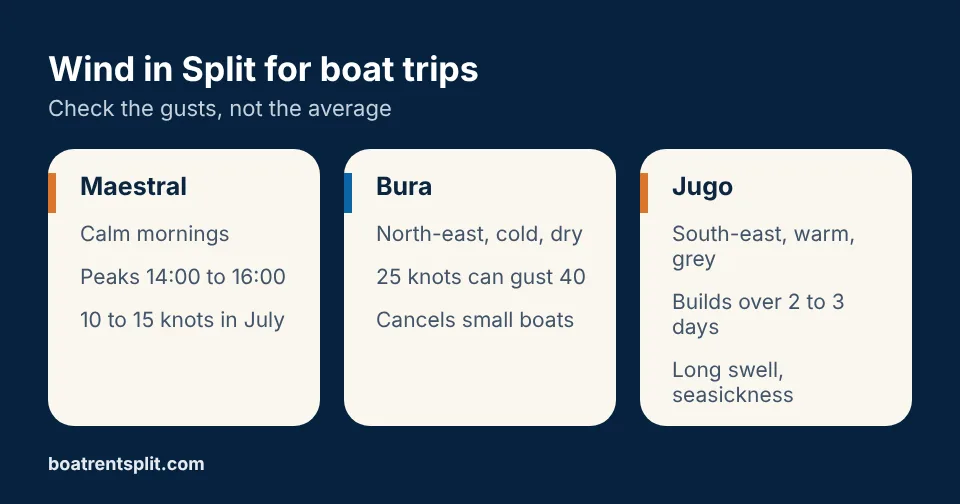
Wind in Split comes down to three names. The maestral is the normal summer afternoon breeze. The bura is a cold, gusty wind from the north-east that cancels small-boat trips. The jugo is a warm wind from the south-east that builds a long swell. Check the forecast the day before, and look at the gusts, not the average.
| Wind | Direction | What you feel on a small boat |
|---|---|---|
| Maestral | West to north-west, summer | Calm morning, chop from midday to late afternoon (Ultra Sailing) |
| Bura | North-north-east to east-north-east | Violent gusts, short steep waves, often clear sky (Ultra Sailing) |
| Jugo | East-south-east to south-south-east | Warm, grey, rain and the biggest waves on the Adriatic (Ultra Sailing) |
We are a booking site, not a weather service. The final call on a bad-wind day belongs to the skipper or the owner.
Maestral: the summer wind that runs on a clock
The maestral is a thermal wind from the west or north-west. Ultra Sailing says it starts around 9 to 10 in the morning, eases around noon, peaks around 2 pm and has a last push around 5 pm. Navy Blue Yachting puts a normal July day at 10 to 15 knots, peaking between 14:00 and 16:00, and dying toward sunset.
On a Split day trip this is why mornings feel like a lake and the ride home can bump. Plan the longest crossing early, swim and eat in the middle, and expect a chop on the way back. A small boat feels it more than a big one.
Bura: the wind that cancels boat trips
The bura blows from the north-east. Ultra Sailing describes it as dry and very cold with violent gusts, and short, steep waves with foam. A winter bura can last up to two weeks. In summer Split City Excursions says it typically lasts one to two days.
The gap between average and gust is the danger. Navy Blue Yachting gives an example of a 25-knot forecast gusting to 40. The sky is often clear and sunny, so guests are surprised when the boat stays in port. The sea state is the problem, not the sky.
A good sign for the day after: Split City Excursions notes that days right after a bura are often the best for boat trips.
Jugo: grey sky and a long swell
The jugo is a warm wind from the east-south-east to south-south-east. It builds slowly. Ultra Sailing says it reaches maximum strength after two or three days of steady blowing and brings the largest waves of the Adriatic and plenty of rain. Split City Excursions says it can last several days, especially in spring and autumn.
Gusts matter less here. The swell does. A long rolling sea is the condition that makes people seasick, and it keeps rolling after the wind eases (Navy Blue Yachting). If anyone aboard gets sick easily, ask for a calmer route or move the day.
How strong is too strong: the Beaufort scale
Forecasts for wind in Split quote knots or Beaufort force. The Met Office Beaufort table gives these open-sea figures:
- Force 4: 11 to 16 knots, slight to moderate sea, about 1 m waves.
- Force 5: 17 to 21 knots, moderate sea, about 2 m waves.
- Force 6: 22 to 27 knots, rough sea, about 3 m waves.
- Force 7: 28 to 33 knots, rough to very rough, about 4 m waves.
The Met Office figures are for well-developed waves on open sea. For wind in Split's island channels the sea will often be lower. Read them as a guide, not a promise. We do not give a legal wind limit for rental boats, because we found none in the sources above. The owner or skipper sets their own.
Which boat copes with wind in Split
- RIB. Light and quick, but open. Our RIB rental in Split page says to think twice on rough days and long trips with kids.
- Speedboat. Fast enough to cross before the afternoon wind builds. Open boats still take the chop. See speedboat rental in Split.
- Catamaran. Two hulls move less, especially at anchor. See catamaran rental in Split. It is slower, so plan fewer stops.
Not sure which to choose? Read speedboat vs catamaran in Split or which boat to rent in Split.
Calm-water routes and open-sea routes
Where you go matters as much as what you ride when the wind in Split picks up. Our Blue Lagoon and Šolta trip is a short ride into calm, shallow water. The Blue Cave trip crosses open sea, and our RIB page steers people to a speedboat for it. On a windy forecast, pick the short route or move the long one to another day.
Also see Split to Vis by boat if you plan the long crossing, and the best time to rent a boat in Split for the calmer months.
Wind in Split by season
- Summer: mostly the maestral, with the occasional bura that lasts a day or two (Split City Excursions).
- Spring and autumn: the jugo can last several days (Split City Excursions). Ultra Sailing says it is stormy in autumn in the south Adriatic.
- Winter: the bura is strongest. The levant, an easterly, is frequent in February and March (Ultra Sailing). Few day boats run then. See the best time to rent a boat in Split.
Other winds you will hear about
Skippers name more than three winds. Ultra Sailing lists tramontana (north to north-west, can reach stormy force), ostro (a moderate southerly in summer that comes before the maestral), libeccio (south-west, mostly winter) and ponente (west). It also describes the burin, a night breeze that blows from land to sea and reaches about 5 to 7 miles offshore. You do not need to learn them all. If the forecast shows anything strong from any direction, ask the skipper.
A plan for a windy forecast
- Move the trip to the morning. The maestral builds later.
- Swap the open-sea route for a short, sheltered one.
- Take a catamaran if anyone gets sick easily.
- If a bura is forecast, ask to move the day. Days after a bura are often the best (Split City Excursions).
- Hold the boat for your last full day if your stay is short.
Wind also decides where you can anchor and swim. Read the anchoring rules in Croatia and pack for a chilly return in what to bring on a boat trip in Split.
How to read the wind in Split forecast yourself
- Gusts first. A steady 18 knots is a fine day. 18 gusting 35 is a bura (Navy Blue Yachting).
- Wave height and period together. One metre with a long period is a gentle roll. One metre with a short period is a washing machine (Navy Blue Yachting).
- Direction. North-east means bura, south-east means jugo, north-west in the afternoon is the maestral doing its job.
- Official source. The Croatian meteorological service publishes a marine forecast for small craft. Windy shows the model data.
- Warning signs. Ultra Sailing says thin white clouds over the coastal mountains can announce a bura.
What happens if wind in Split cancels your boat day
Rules differ by owner. One Split operator says weather cancellations are its responsibility and offers a new date or a full refund (Split City Excursions), but that is its own policy, not a rule for every rental. Before you pay a deposit, ask the owner what happens on a bad-wind day and get the answer in writing. Our is it worth renting a boat in Split guide covers what else to confirm.
A bura cancellation usually means good weather the next day. After a jugo cancellation, plan for about two days on land (Split City Excursions). If your trip is short, do land plans first and keep the boat for your last full day.
Rent a boat in Split on the right day
Tell us your date and group size on WhatsApp and we will check the options and the forecast with you. See all boats for rent in Split or how it works.